
God, I’m sick of GitHub.
Where did it all go wrong?
I started coding professionally in 2020, and learned how to use Git for the first time the year before. As many new GitHub users think at first, I thought GitHub was the only way to use Git, and never even considered the fact that there are alternatives.
In September 2025, I had enough of this, and moved all my repositories to SourceHut.
But why would one even use an alternative Git hosting service?
Why I Switched
Consider 2020-2022 as my Git honeymoon. I used to create a GitHub repo for
EVERYTHING. Hell, I still do. My CS homework? The very first thing I did at the
start of each semester was gh repo create for each class. Like a madman, I
even tried to use GitHub for versioning my music compositions at one
point1!
However, this honeymoon would only last a couple of years.
AI Bullshit
The first time I had started to realize that “maybe GitHub isn’t a good platform” was 2023, when GitHub Copilot usage started to increase and the hype creeped into my daily life.
I had never heard of Copilot until that point, and was not interested in most AI tools whatsoever. However, as more people in my life started to use it and professors told us that we would get extra credit for using these AI autocomplete plugins, I gave in. I signed up and integrated it into Neovim for a while2.
The more I looked into and used AI autocomplete tools (not just Copilot, I used Codeium/Windsurf at one point), the more appalled I became. And it wasn’t just because the code completion wasn’t good. Even the way that they sourced data was deeply unsettling for me. My research into this yielded the following questions that I could not find adequate answers for:
- Does training on GPL/other copyleft code make all generated code derivative works, or what I like to call fruit of the copyleft tree3?
- Have authors/owners of code truly consented to letting their code be used for AI training? And no, IMO, a simple EULA is not enough for true informed consent.
- Since code quality on GitHub can be rather questionable, is there any solution to Copilot potentially introducing vulnerabilities and other poor-quality code to a project?
These are just a few questions of many others in the legal gray areas GitHub is trotting in currently with all of their AI offerings. They only are digging themselves into deeper shit, considering that they likely use private repositories to train their models with without admitting so publicly.
Interesting unethical practices, to say the least.
Fun fact, companies used to take these concerns extremely seriously. Even large companies like Apple has restricted use of ChatGPT and Copilot in the past for the same reasons. Yet GitHub keeps peddling AI as a magic tool in many of its products and shoving Copilot into everywhere on the GitHub interface, including pull request reviews.
These aren’t the only problems with GitHub though. Far from it.
Work Gamification
Every company has to figure out some way of keeping retention numbers high, right?
Yes, including companies where more engagement with their software can drive down the quality of the content on it4.
Surprisingly, user retention methods can apply to things OUTSIDE the content creation space (i.e. YouTube, TikTok, the like). And GitHub has figured out a way to make this apply to the entire software development life cycle…
Behold: the contribution graph!.
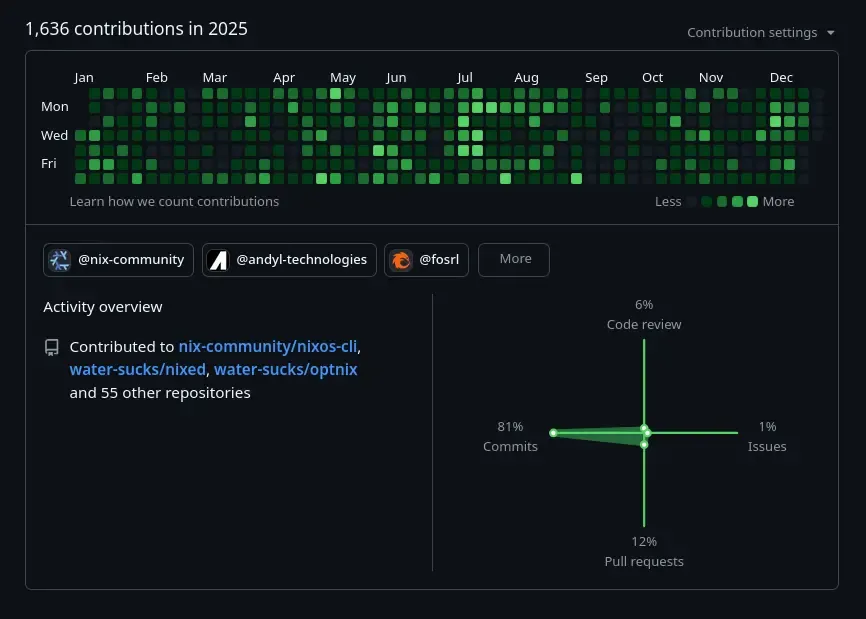
Christ, I used to be OBSESSED with this piece of shit. And I still am sometimes, but nowhere near the extent to which I was5.
Let me explain further.
GitHub incentivizes you to use Git in the way that they have intended. And frankly, that means using every single resource on their platform. Filing issues, making pull requests, and commits that land on default branches all result in so-called “contributions”. And WAY too much emphasis is placed on this stupid green graph by some people, including prospective employers. That’s just bonkers to me now.
This causes people to either spoof commit history, create small commits solely for getting darker squares on the graph, and even make AI-generated spammy pull requests6 for the resume’s sake. It makes maintainers’ lives hell, decreases code quality, and all for what? A green graph?

This is definitely a smaller problem than the others, but it’s still something that has annoyed me ever since I noticed it in my own behavior. Something had to change.
Pull Requests: The Antichrist’s Git Workflow
Git branches originally worked best with local workflows.
GitHub changed that, and did so radically. No, radical does not necessarily mean good in this case.
They made branches the primary means of communication between developers, rather than the commits themselves (I’ll call commits “patches” and a series of them a “patchset” later on). I didn’t know when I first started using Git at first, but this was not the original way Git was designed to be used.
Linus Torvalds, the creator of Git himself, has historically LAID into GitHub for this branch-based contribution model, and they’ve simply ignored him and continued on with their ways7. Opinionated is good and all, but not when the opinions are just bad.
GitHub’s pull request UI is breathtakingly terrible once you start to see its flaws. First off: diff soup. Diff soup has genuinely made my life hell in many instances at work and in open source as well.
What is diff soup, you may ask? I define diff soup as large pull requests that make it extremely hard to find the context and/or history of a given patchset and the corresponding reviews/its evolution over time.
Let’s do a small case study.
Take a large pull request such as this one that introduces a C API to the Nix package manager. It went for more than a YEAR before getting merged, with hundreds of review comments in a flat thread. If we’re talking code smells, this is a fucking sewer.
Observation I: It’s basically impossible to find the thread of conversation, since many comments apply to code that simply does not exist anymore. Fun fact, GitHub oftentimes simply does not display some review comments when their corresponding diffs disappear. That’s because the whole diff is displayed as it was in its most recent form. You can’t view what the repository was like before, unless you stack your commits on top of previous ones. So if you want previous review comments, you basically have to say your farewells to rebasing.
Sure, there are “outdated” comments, but those get applied to different comments somewhat inconsistently and it’s irritating.
Observation II: Speaking of the actual diff view, some diffs can be MASSIVE. The GitHub UI is very limited in what it can show, and you can’t exactly slice up a diff and talk about suggestions outside of the changed code that may have been affected. So the code review process itself is also limited in that way.
Observation III: The very notion of “resolving” comments is overrated in its current form. They’re just a way to hide comments (both “outdated” AND “up-to-date” comments; “resolved” and “outdated” are too similar, to be frank). Just look at the PR and how many resolved comments there are; how many more are actually related to the up-to-date code on that branch anymore?
Also, pet peeve of mine: for some reason, an author can resolve comments without actually acknowledging or applying the reviewer’s requested changes. They really shouldn’t be allowed to do that; the original commenter should mark it as resolved after having the appropriate discussion or verifying the requested changes have been made.
Oh, and don’t get me STARTED on the terms GitHub uses for merging strategies for pull requests.
- Create a merge commit :: this is the pull request merging strategy GitHub incentivizes, and these merge commits are ugly as FUCK.
- Squash and merge :: this turns the whole branch diff into a single commit and fast-forwards the target branch with the new squashed commit. NO, it does NOT create a merge commit, as the name seems to suggest.
- Rebase and merge :: God FORBID we use the right fucking terms for Git operations. THESE ARE CONTRADICTORY TERMS! IT’S JUST REBASING ON TOP OF THE TARGET BRANCH, YOU FUCKS!
As you can see from my sailor’s mouth, this is a subject that will ALWAYS cause me to crash out when it comes up.
As if we couldn’t have more problems with the pull request workflow, GitHub has no interest in preserving GPG signatures through the latter two strategies. In order for you to keep GPG signatures, you HAVE to use merge commits. And we already know how ugly those end up looking in the subsequent history8.
They put in all this work for showing GPG signatures alongside code, and they don’t even support it properly when merging a pull request into mainline branches? Laughably negligent and lazy on GitHub’s behalf.
And no, gh pr does not make using GitHub pull requests easier. If anything,
it’s just a shitty replica of the web UI in CLI form.
The flawed pull request flow is ultimately what caused me to get so fed up with GitHub as time went on. I was curious about how projects like the Linux Kernel Mailing List (LKML) and PostgreSQL handle contributions, since they’ve gone on for decades without needing GitHub whatsoever. Not to mention Git was literally DESIGNED for the LKML, so I wanted to see how Git was originally meant to be used.
Enter SourceHut.
Getting Started
I saw SourceHut for the first time when looking at Zig, sometime in mid-2023. I
noticed that some of their CI infrastructure ran on builds.sr.ht (specifically
FreeBSD), and was curious about what SourceHut offered.
One of the very first things I saw was that it was created by Drew DeVault, and
that got me very interested. While the dude is very polarizing, I tend to like a
lot of his takes on software, and I also love using Wayland (using
riverwm at time of writing).
I actually ended up purchasing a subscription to support his efforts in July 2023, but never used the platform until September 2025. That’s when I finally snapped, and GitHub had given me enough trouble. Diff soup was one thing, but I had finally come to the realization that until GitHub takes its head out of its own ass with regards to AI, I had no business of keeping my primary means of development there. Plus, I really badly wanted to learn how to use Git with email, and I figure diving into the deep end headfirst is the best way to do so9.
Hold On, Why Not GitLab/Forgejo/Gitea Or Something Else?
Some of the problems I have with these platforms are similar to the one with GitHub, minus the AI bullshit I suppose.
For them, it’s not exactly the project/entities behind them as much as they copy the GitHub model of pull requests that I have started to dislike.
Feel free to send me an email for further discussion.
Porting Repositories
I’m not gonna lie, porting repositories was literally seamless. After adding my
SSH keys (both my gpg-ssh-agent key and a machine-specific one), I just ran:
$ git remote set-url origin git@git.sr.ht:~watersucks/<repo-name>in each one of my repos and pushed them up. SourceHut automatically created a private repository for each of these, and then I toggled their visibility to “public” and voila! My repos were ported over.
Not so fast, what about discoverability?? Great question.
GitHub Mirroring
GitHub is popular because everyone uses it. Now, I don’t have to necessarily USE the GitHub facilities, but I can optimize my own projects for both drive-by GitHub contributors AND SourceHut users by mirroring my repository to GitHub on every push.
Here comes builds.sr.ht to save the day!
I created a (mostly) identical build manifest in each repository at
.builds/mirror.yml:
image: alpine/edge

secrets:
  - <GITHUB_TOKEN_SECRET>

sources:
  - https://git.sr.ht/~watersucks/<repo-name>

tasks:
  - write-ssh-config: |
      cat >> ~/.ssh/config << EOF
      Host github.com
        IdentityFile ~/.ssh/srht_github_mirror
        IdentitiesOnly yes
        BatchMode yes
        StrictHostKeyChecking no
      EOF
  - mirror: |
      cd ~/<repo>
      git remote add github git@github.com:water-sucks/<repo>.git
      git push --mirror github

triggers:
  - action: email
    condition: failure
    to: 'Varun Narravula <varun@snare.dev>'
Once I pushed it up, SourceHut automatically ran this manifest and synced the repository to GitHub on every push. I put up a notice in the READMEs and on the GitHub repository description that the primary sources were at SourceHut, but that I would still accept pull requests and issues, and mirror them over into SourceHut when applicable.
Now, there are limitations to these build manifests, which I’ll go over later. But so far, this move was going pretty well.
Patch-Based Email Workflow
Now comes the hard part: figuring out the email-based workflow.
I had to create mailing lists for each project already, and followed the
recommended layout of having three lists: <repo>-devel, used for
development/sending patches, <repo>-announce for announcing releases/breaking
changes and other such things, and <repo>-discuss for general discussion.
Now, I didn’t expect much engagement at all, and that’s fine. Most people are simply not going to know how to even interact with SourceHut properly, since the documentation is sparse10 compared to GitHub. But at the very least, I had to set something up in order to respond to these things/create patches myself for other projects on the platform.
To that point, I found aerc, Drew DeVault’s own
email client11. It seemed really cool to manage email through
the terminal, so I picked it up, added it to my
home-manager configuration, and
watched a metric shit-ton of videos on how to do email-based workflows.
Basically, the idea is this when submitting patches:
- Do development on a local branch, make your commits.
- Once your commits are ready, run
git format-patchon the patchset. - Send the patchset off with
git send-emailto the proper mailing list, optionally with a cover letter. - If changes are requested, then send another version of that same patchset
after applying the requested fixes.
git send-emailandgit format-patchsupport versioning patchsets like this, and even implement tooling around diffing between patchsets in the form ofgit range-diff. I’ll talk about my workflow around this in a later post, so stay tuned. - Otherwise, wait for the patch to get accepted and for a reply!
Branches in this flow are for local development organization only. This is a COMPLETE mindfuck compared to the GitHub flow, and took me a minute to get used to.
For my own projects, branch organization was still great, but all my commits
simply ended up on main, since I was the trusted core maintainer. In GitHub
land, I would not configure this sort of access, even to my own main branch. I’d
always make pull requests to main and self-merge instead. I’m not gonna lie,
this made much more sense than the GitHub way.
When you are accepting patches from a list, the flow goes like this:
- Open
aercto find the patch email(s). - Check out the main development (trunk) branch.
- Pipe the contents of the email(s) to
git am. - Make sure shit works.
- If good, then rebase it into your trunk and push it up, and reply back with a “Thanks!” and the new, merged commit ref.
- Otherwise, slice up the diffs, and review them by simply editing the patch itself inline.
You wanna know something funny, dear reader?
My first contributed patch on SourceHut was to SourceHut itself.
At least one that wasn’t to my own project.
I ended up fixing a bug with the issue tracker todo.sr.ht itself that I found
when attempting to resolve one of my issues automatically through email. This
was super annoying at the time, but it does highlight the fact that SourceHut is
not perfect.
Hear Ye, Hear Ye! What Problems Have Arisen, My Dear SourceHut?
Let’s talk about some other problems.
Fixing bugs with the platform itself is one thing. I like using alpha software and contributing fixes back, but this can interfere with my own project development. I am not employed by SourceHut, so any bugs with it that I must fix must come out of my own time.
GitHub’s Monopoly
I’ve mentioned this earlier, but I am still somewhat stuck in the GitHub ecosystem for multiple reasons.
First off, at the time of writing, I still use Nix and have many projects in the
NixOS space. I maintain
nixos-cli, and including a
project in nix-community for visibility requires me to use GitHub for the
upstream. I could develop it on SourceHut personally, but mirroring a repo like
this seems like an unreasonable waste of SourceHut compute when I’m gonna
contribute it to the GitHub upstream anyway.
Additionally, the Neovim plugin ecosystem often assumes GitHub as a default when
using owner/repo style syntax for including plugins. My own
darkrose.nvim colorscheme is
mirrored to GitHub for precisely this reason, to make it easier to use.
Also, my workplace (Pangolin) heavily uses GitHub for its open source hosting and for free GitHub Actions compute. If I want my paycheck, GitHub it is when I’m on my 9-5.
builds.sr.ht Usability Issues
builds.sr.ht, while it is remarkable for what it offers, is missing some
features that I sorely miss from GitHub Actions, such as cronjobs (i.e. for my
weekly NixOS configuration flake updates)12.
It’s also somewhat limiting to only be able to run 4 jobs on every push, but I understand this limitation; build compute cannot be free forever, think of the trees!
One more gripe with builds.sr.ht: for public projects, where do I send build
failures? Does it happen automatically with CI? Mailing list CI is just very
confusing, and I don’t get who receives the notifications. I don’t want everyone
in a <repo>-devel list to receive notice of my own stupid mistakes, and I
don’t want to see contributors’ CI failures either. Triggers aren’t very
flexible at the moment, and I don’t know how to expand them properly. If someone
knows how, send me an email, I’d appreciate it.
External Usability
This is always gonna be a fundamental problem with SourceHut, in my opinion.
The thing is, people have been so conditioned by GitHub to expect the contribution process to be streamlined for them. That’s because GitHub is HEAVILY optimized for drive-by contributions. Any stupid person can make a pull request without explaining the purpose of it properly. The very nature of sending patches over email is intimidating for many Git users, and will tend to invite more experienced developers rather than noob ones.
The analogy I make: since GitHub is optimized for drive-by contributions, SourceHut simply wants you to park your damn car and to be more persistent for a change. It’s a good attitude to have, and one that I share.
However, this drives down contributions massively. Even in my own GitHub repositories, I see people that fork them, have changes in separate branches, but have not made pull requests despite me saying that it is okay.
Some days, I fear that because of this barrier to entry, SourceHut may never gain popularity and be stuck in a forever cycle of this. But perhaps that is for the best; who knows?
I still do get quality contributions over email, just less of them than I would have otherwise received in the form of a GitHub pull request. And that’s fine for now.
What The Future Holds
In the future, I may have figured out my problems and gripes with SourceHut, and may write a future post about that as well. Stay tuned!
Fin.
Footnotes
-
Yeah, don’t do this. The file limits are rather low for GitHub and even with Git LFS, the actual size of the repo explodes and you won’t be able to host it eventually. Not to mention who cares about how music projects evolve? Most people just want the finished product, not shitty half-finished demos. ↩
-
I actually gave up using it. The signal-to-noise ratio was laughably low for completions, and even when I set Codeium off by default, I found that I would never really enable it. And not because I forgot it existed; I just didn’t care much for the output even when I enabled it. ↩
-
“Fruit of the copyleft tree” is a term I came up with to refer to code that should be available on request due to GPL/other copyleft licensing. It’s a play on “fruit of the poisonous tree” in legal cases. I really like this phrase, since I came up with it while stoned. ↩
-
My belief is that as the size of a platform grows, so does the amount of slop on it. With ALL of these big tech platforms, user retention tactics often end up assisting in the creation of more frequent trash content and end up tanking the signal-to-noise ratio for good content. Content in this case doesn’t only mean videos/other media, it also means project activity, like code contributions, bug reports, and documentation updates. ↩
-
I actually bought a domain, cgraph.dev, which I was gonna make a small platform-agnostic contribution graph for. However, I haven’t really worked on this at all, and have been considering just giving up on it for the same reasons I mention here. ↩
-
If you want to hurt yourself in confusion, see the following AI-generated merge request to the Mesa project on GitLab. Some idiot had the absolute fucking GALL to say they didn’t know what they were doing and were submitting a patch to a low-level Linux graphics stack ANYWAY. I wish I could throw people off building sometimes.
Side note: We should all aspire to be like Timur in that merge request. ↩
-
I don’t regard Torvalds as a god. I disagree with him on plenty of things, but agree with him in this instance about GitHub. Don’t come after me for citing his ethos. ↩
-
Yes, it is possible to merge without the GitHub UI. But then you don’t even get a way to automatically close the pull request with a “merged” status! Daniel Stenberg, the
curlmaintainer, has mentioned this on his own blog post on his own Git workflow, and you can see how stupid funny it looks by looking at thecurlpull request list, where they all show up as closed. ↩ -
I did this with NixOS, all the way back in 2020 or so. Ended up wiping my Void Linux drive by accident from the NixOS installer ISO with
ddand it’s now my daily driver. So I’m used to this kind of uprooting thing and learning the hard way :} ↩ -
I seem to have a fondness for cool projects with poor/subpar/sparse docs: Nix, Zig, and now SourceHut. I have a fucking problem. ↩
-
He apparently doesn’t maintain the project anymore, it’s someone else now. But still, cool fact I guess. ↩
-
I use cron-job.org to do this every Saturday, and all it does is use the SourceHut GraphQL API to send an ad-hoc build manifest that I have to MANUALLY keep in sync with what’s in the repo. Genuinely so stupid lol. ↩